How to Manage Omnichannel Customer Service: A Guide for Global Teams
Global teams struggle with scattered messages and unclear assignments across channels. Centralizing inquiries into one workspace reduces repetitive tasks

For businesses operating in international markets, customer communication is no longer limited to a single platform. Channels such as WhatsApp, Telegram, Instagram, Facebook, and email have gradually become important ways for businesses to receive customer inquiries and maintain customer relationships.
As businesses grow, their communication challenges also become more complex. Customer service representatives need to handle messages across multiple platforms, sales representatives need to follow up with customers from different sources, and managers need to keep track of team performance and customer service progress.
If every team member manages their own accounts and customers independently, increasing the team size does not necessarily lead to better productivity.
What truly affects team efficiency is how messages are assigned, who is responsible for each customer, and whether team members can share information in a timely manner.
So, how can businesses build a more organized omnichannel service and team collaboration workflow?
1. Why Do Teams Need to Rethink Their Customer Service Workflow?
In traditional customer communication workflows, different team members usually manage different social media platforms or business accounts. This approach may work well when a business is relatively small. However, as the number of channels and customer inquiries increases, the existing workflow can become difficult to manage.
1.1 Messages Are Scattered Across Different Platforms
Customer service representatives need to open WhatsApp, Telegram, Instagram, and other platforms separately to check incoming messages.
When multiple accounts receive new messages at the same time, employees must constantly switch between platforms to handle daily inquiries.
This not only increases the number of operational steps but also makes it easier to overlook some customer messages.
1.2 Customer Assignment Is Unclear
When multiple team members handle customer inquiries, the lack of a clear assignment process can lead to duplicate replies or customers being left without follow-up.
For example, a customer may first contact a business through Instagram and later reach out through WhatsApp. If different employees handle these conversations without sharing customer information, the customer may receive repeated questions or inconsistent responses.
1.3 Customer Information Is Not Shared Effectively
Customer communication is rarely a one-time interaction. In international trade, the process often involves several stages, from initial inquiries and product discussions to quotations and ongoing business relationships.
If customer profiles and communication records are scattered across different team members, other employees may find it difficult to understand a customer's background when taking over a conversation.
1.4 Managers Have Limited Visibility Into Team Operations
Managers need to know more than whether customers have received replies. They also need to understand message handling progress, employee responsibilities, and customer follow-up activities.
If they can only review chat records on individual platforms, managing the entire team becomes much more complicated.
2. Build a Unified Messaging Workflow to Reduce Repetitive Tasks
The first step toward improving team efficiency is to centralize message handling.
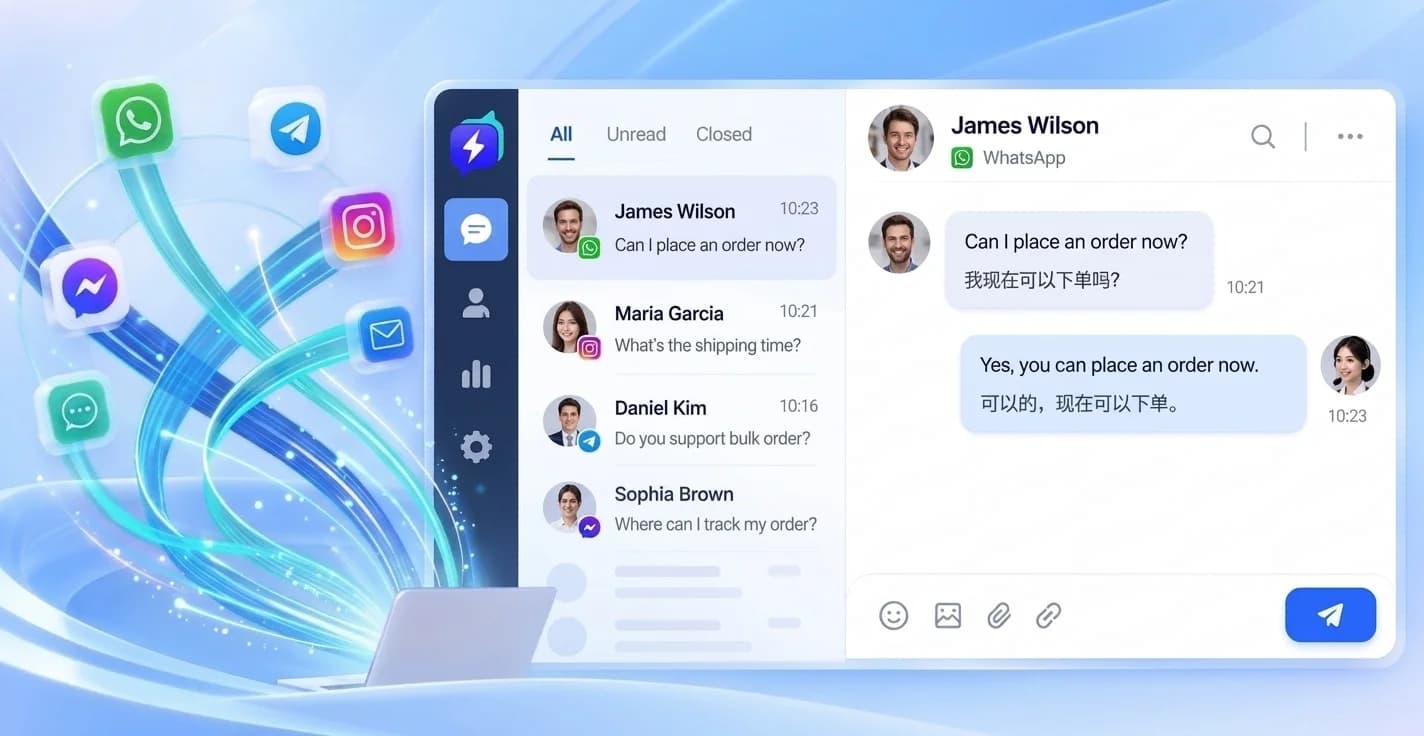
Businesses can use an omnichannel customer service platform to bring customer messages from different channels into one workspace, allowing employees to handle inquiries without constantly switching between platforms.
For example:
WhatsApp inquiries can be viewed in a unified workspace.
Telegram messages can be managed alongside conversations from other channels.
Instagram inquiries can be handled within the same working interface.
Customer messages from different channels can be followed up according to team responsibilities.
The goal is not simply to put messages together. It is to create a more consistent working environment where teams can manage daily customer communication.
Once messages are centralized, employees can check pending inquiries more easily and spend less time switching between different accounts.
To learn more about this feature, explore SalesQuickly's Multichannel Management Feature.
3. Customer Assignment: Make Sure Every Inquiry Has a Clear Owner
After centralizing customer messages, businesses need to address another important question: Who is responsible for each customer?
For teams with multiple members, clearly defining customer ownership is essential.
3.1 Assign Customers by Business Function
Businesses can organize customer responsibilities according to customer needs and business functions.
For example:
Sales representatives handle pre-sales inquiries.
Customer service representatives handle product usage questions.
Dedicated support teams handle after-sales issues.
Key accounts are assigned to specific sales representatives for ongoing follow-up.
Clearly defined responsibilities help reduce conflicts and unnecessary overlap between team members.
3.2 Assign Customers by Market or Region
Businesses operating in multiple countries and regions can also assign customers according to their target markets.
For example, team members responsible for the European market can handle inquiries from that region, while another team focuses on customers in Southeast Asia.
This allows businesses to organize their teams according to their actual market requirements.
3.3 Preserve Customer Communication History
Customers may need to be transferred between team members at different stages of the customer journey.
Therefore, customer handovers should include more than just contact details. Relevant customer profiles, previous messages, tags, and follow-up records should also be preserved.
This helps the next team member understand the customer's needs more quickly and avoid asking the same questions again.
4. How Does Multi-Account Management Support Team Collaboration?
For businesses operating multiple overseas social media accounts, account management is another important part of team collaboration.
For example, a cross-border e-commerce business may operate several WhatsApp accounts for different product lines, markets, or business teams.
If every account is managed independently by different employees, managers need to spend additional time checking account ownership, usage, and team responsibilities.
Businesses can improve this process in three ways.
First, centralize business account management.
Connect the communication accounts required for different business operations to make account management more organized.
Second, define employee permissions.
Set team member permissions according to their roles and responsibilities so that employees can work within their assigned scope.
Third, connect account management with customer follow-up.
Businesses should not only focus on whether accounts have been connected. They should also pay attention to whether customer inquiries are handled promptly and who is responsible for subsequent follow-ups.
5. Team Collaboration Also Requires Unified Customer Profiles and Follow-Up Records
Message handling is only one part of customer communication. Maintaining long-term customer relationships also requires complete and accessible customer information.
For sales and customer service teams, customer profiles should help employees quickly understand each customer's background and current status.
Businesses can organize the following information:
Basic customer information.
Customer acquisition channels.
Customer interest tags.
Historical communication records.
Current follow-up status.
Upcoming follow-up tasks.
For example, an overseas customer may have already asked about product pricing and expressed an interest in purchasing.
If this information is recorded in the customer profile, another sales representative can review the previous conversation and continue the discussion without asking the customer the same questions again.
Managers can also use customer profiles and follow-up records to better understand business progress.
6. How Does SalesQuickly Help Businesses Improve Team Collaboration?
SalesQuickly (SQ) is an AI-powered omnichannel communication and customer management platform designed for businesses operating in international markets.
To address common challenges in multichannel customer service and team collaboration, SalesQuickly provides several management features.
1. Unified Multichannel Message Management
SalesQuickly supports integration with WhatsApp, Telegram, Messenger, Instagram, and email, helping teams view and handle customer messages from different channels in one workspace.
2. Customer Profiles and Tag Management
Customer profiles, tags, and follow-up records help teams organize customer information, making it easier to search for details and maintain ongoing customer relationships.
3. Team Member and Permission Management
Team management and permission settings help businesses organize responsibilities according to employee roles and job functions.
4. Customer Assignment and Automation
Customer assignment and automation rules help reduce repetitive tasks and make customer inquiry handling more organized.
5. Real-Time Two-Way Translation and AI Assistance
For communication with customers from different countries and language backgrounds, real-time two-way translation helps team members communicate more effectively. AI question answering and knowledge base features can also improve everyday response efficiency.
For businesses managing multiple overseas communication channels and customer service representatives, a unified workspace can reduce unnecessary operations and make customer communication more organized.
7. How Can You Tell Whether Team Collaboration Has Improved?
After optimizing their communication workflows, businesses can evaluate their progress through several practical questions:
Can team members view and handle messages from different channels in one place?
Does every customer have a clearly assigned follow-up owner?
Can customer profiles and previous communication records be accessed easily?
Has duplicate customer handling between team members been reduced?
Can managers monitor team operations more efficiently?
Has multi-account management become more organized?
These questions can help businesses identify remaining gaps in their customer communication processes.
Conclusion
The value of omnichannel communication is not simply about connecting more customer channels. More importantly, it is about creating effective coordination between different channels, customers, and team members.
From centralized message handling to customer assignment, account management, and customer information records, every step can affect overall team efficiency.
As businesses continue to grow, they need to gradually move from fragmented communication to a more centralized and organized collaboration model.
Through multichannel integration, unified messaging, customer management, and team collaboration features, SalesQuickly helps international businesses optimize their everyday customer communication workflows.
If your team is also dealing with fragmented messages and complex multichannel customer management, register for SalesQuickly for free and explore a more efficient approach to omnichannel customer communication.
Originally published by SalesQuickly. Please credit the source when reposting.