How to Choose a Customer Service System for Going Global: An Essential Checklist for Channels, Translation, and Customer Management
The article outlines a checklist for global customer service systems, emphasizing channel integration, real-time translation, and unified customer profiles to
As brands accelerate their expansion overseas, many teams invest heavily in front-end traffic acquisition and marketing, only to repeatedly stumble at the very last step: customer communication.
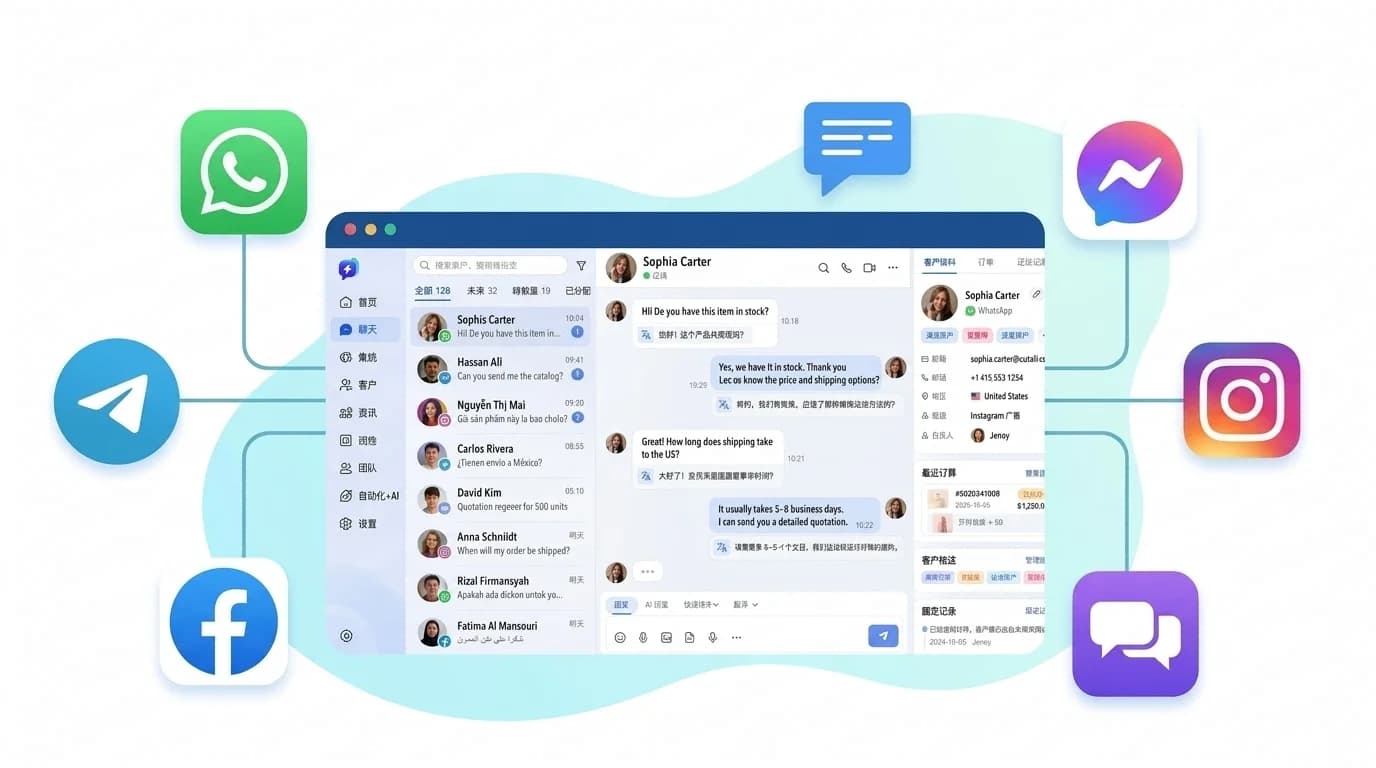
Customer service agents often have to juggle multiple platforms simultaneously—such as WhatsApp, Instagram, Telegram, and email—switching tabs back and forth across various chat windows. When faced with multi-lingual inquiries from Southeast Asia, the Middle East, or Europe, they are forced to rely on external translation software for endless copy-pasting. What is even more serious is that customer messages across different channels remain isolated; when a salesperson resigns or a handoff occurs, customer profiles and communication histories instantly break off.
How can you break through the "fragmented channels," "isolated data," and "multi-lingual barriers" in global communication? Choosing a qualified customer service system for global enterprises is crucial. This article provides a clear checklist of evaluation criteria to help businesses navigate their options and find a solution that genuinely fits their operational needs.
I. Channel Integration Capability: Can It Connect Fragmented Touchpoints?
The first step in evaluating a system is to check whether it covers all customer touchpoints in your target markets and whether the integration methods are flexible enough.
Full Coverage of Mainstream Channels: A qualified system should not just support one or two major platforms; it needs to centrally integrate WhatsApp, Telegram, Facebook Messenger, Instagram DM, email, and website live chat widgets (Chat Widget).
"Dual Integration" of Official APIs and Personal Account Hosting:
Official API Integration: Such as the WhatsApp Business API, suitable for medium-to-large enterprises or compliant marketing scenarios, offering stability and reliability while supporting template message delivery.
Personal Account Hosting: For many emerging cross-border SMEs that temporarily lack official API permissions, supporting the QR code hosting of WhatsApp or Telegram personal accounts allows the entire team to share existing accounts for collaborative reception, significantly lowering entry barriers and initial deployment costs.
II. Translation and Communication Aids: Can They Ensure Efficient Cross-Lingual Responses?
Language communication costs often directly determine the conversion efficiency of overseas leads.
In-Window Real-Time Translation: Eliminating the need to frequently copy and paste between chat software and third-party translation webpages, the system should provide two-way real-time translation directly inside the chat interface, automatically detecting multiple national languages and allowing agents to communicate smoothly with global customers using their native language.
Canned Responses and Sales Material Library Management:
One-Click Canned Responses: Uniformly manage the team's high-frequency FAQs, promotional terms, and negotiation templates, allowing agents to send them with a single click during conversations to ensure consistent external messaging.
Centralized Storage of Sales Materials: Support quickly inserting product images, introduction videos, and PDF files directly into the chat window without repeatedly searching local files, accelerating onboarding for newcomers.
III. Customer Management Capability: The Watershed from "Receiving Messages" to "Managing Assets"
A customer service system is not merely a tool for sending and receiving messages—it is the core system through which enterprises accumulate overseas customer assets.
Cross-Channel Customer Profiles: Automatically aggregate customer contact information and historical conversations across various channels to form complete customer profiles and conversation records, preventing customers from having to re-identify themselves when switching channels.
Customer Status and Tag Classification: Support custom tagging based on customer sources, business dimensions, or follow-up stages, with clear customer status markers to help teams orderly accumulate customer data for subsequent filtering and targeted nurturing.
IV. Team Collaboration and Cost Control: Can It Balance Efficiency and Security?
System selection must not only satisfy individual agent needs but also align with standards for team management and business operations.
Multi-User Collaboration and Chat Assignment: Support flexible member management and role permission configuration, providing chat assignment features so pre-sales, post-sales, or multi-lingual inquiries can be rapidly routed to corresponding members.
Data Dashboards and Operational Overviews: Managers can use data dashboards to track team response efficiency, total chat volume, and handling status at any time, driving operational optimization with data.
Trial Costs and Upgrade Paths: Prioritize platforms that offer free versions or flexible pricing tiers (such as free trials for basic features and on-demand paid upgrades) to lower procurement and trial-and-error barriers for small teams.
Compliance and Data Security: Legitimate platforms must ensure secure data transmission and storage, strictly complying with target market privacy requirements such as GDPR to guarantee enterprise data asset security.
V. Matching Solutions by Business Type
Business Type | Core Communication Pain Points | Key Focus Capabilities | Recommended Selection Focus |
Cross-Border E-commerce & Independent Sites | High volume of pre-sales inquiries, complex multi-lingual environments, and slow response times leading to cart abandonment | Omnichannel aggregation + real-time translation + rapid material sharing | Focus on response speed and multi-lingual communication efficiency to prevent missing high-frequency inquiries. |
B2B Foreign Trade Enterprises | Long inquiry cycles, channels split between email and WhatsApp, and high customer loss risk due to staff turnover | Cross-channel customer profiles + tag management + historical record retention | Focus on customer asset retention and cross-channel record synchronization to prevent resource fragmentation. |
Social Media Acquisition Teams | Fan inquiries scattered across individual IG/FB/TG accounts, making it difficult for multi-person teams to share and handle accounts | Personal account QR code hosting + team collaborative assignment | Focus on multi-personal account integration and multi-user shared account collaboration to lower operational barriers. |
Startups & Micro Cross-Border Teams | Limited manpower, tight software procurement budgets, and high maintenance costs | Basic free version + ultra-simple usability + unified inbox | Focus on high cost-performance and minimalist operation for out-of-the-box rapid deployment. |
Frequently Asked Questions (FAQ)
Q1: What is the biggest difference in selection between domestic and overseas customer service systems?
A: Domestic customer service systems mostly focus on the WeChat ecosystem, domestic e-commerce, and telephone customer service; whereas overseas customer service systems must deeply integrate mainstream overseas ecosystems (such as WhatsApp, Telegram, Messenger, Instagram, and overseas email) while demanding extremely high standards for multi-lingual real-time translation and overseas data compliance.
Q2: Is a full-channel customer service system still necessary for a small team of only 2–3 people?
A: Absolutely necessary. The smaller the team, the more precious manpower is. If a small team spends their days switching back and forth between multiple apps, they are even more likely to miss critical inquiries. Utilizing a system's unified inbox and script/translation assistance empowers a 2–3 person team to efficiently cover multiple global channels. It is recommended to choose systems offering free basic tiers to get started.
Q3: How should I choose between personal account hosting and official APIs when selecting channel integration?
A: They are not mutually exclusive alternatives, but rather suited for different scenarios. If your business is mature and requires compliant group broadcasting and template messages, official APIs are the top choice. If you are in the startup phase, using social media personal accounts to accumulate customers, or temporarily lack API application qualifications, choosing a system that supports personal account QR code hosting can help you quickly achieve multi-person collaborative team reception.
Conclusion
Choosing a suitable overseas customer service system is essentially building a bridge for efficient communication between enterprises and global customers. Only by organically combining omnichannel integration, multi-lingual real-time translation, and cross-channel customer management can you truly transform inquiries scattered across the globe into manageable, operational commercial assets.
Originally published by SalesQuickly. Please credit the source when reposting.