How to Manage Multiple Accounts? A Guide for Global-Facing Teams on Centralized Social Media Account Management
The article outlines managing global social media accounts by addressing pain points like missed messages and security risks. It emphasizes compliance, using

In the daily operations of cross-border e-commerce and overseas localized business, social media private domains (such as WhatsApp, Telegram, Messenger, and Instagram) have become core battlegrounds for overseas customer acquisition and retention. However, as business scale expands, global teams often need to operate dozens or even hundreds of overseas accounts simultaneously.
When the number of accounts and customer service personnel increases, multi-account management becomes the biggest bottleneck restricting efficiency and account security for global teams. Combining actual overseas business experience and a compliance-security framework, this article comprehensively analyzes how global teams can scientifically implement multi-account management to achieve unified reception and risk prevention.
I. Core Pain Points: The "Five Invisible Killers" of Multi-Account and Multi-Agent Collaboration
Whether operating multi-store matrices, personal accounts without official APIs, or cross-timezone shift receptions, global customer service teams often face the following typical dilemmas before establishing a standardized management system:
Missed Messages and Response Delays: Agents must switch frequently between multiple web pages and apps, making multi-login extremely tedious and causing messages to be overlooked in corners, keeping customer churn rates high.
Duplicate Follow-Ups and "Double-Booking": When multiple agents share accounts without a status synchronization mechanism, the same overseas customer may be answered by multiple agents simultaneously, which not only lowers customer trust but easily triggers internal performance disputes.
Difficult Customer Handoffs: When agents resign or shift duties between pre-sales and post-sales, historical chat logs remain scattered across individual phones or personal accounts. Handover becomes a "blind grab," leading to the loss of high-value customer assets.
Late Discovery of Abnormal Disconnections: Disconnections caused by network fluctuations or expired authorizations are often only noticed when customers complain through other channels, missing the optimal response window.
Risk Control and Security Blind Spots: Account passwords are shared among multiple people, lacking permission controls and operation log records. Once sensitive remarks or unauthorized operations occur, responsibility cannot be traced.
II. Risk Control Boundaries: Security and Compliance Are the Lifeline of Multi-Account Management
When implementing multi-account management, global teams must first clarify the boundaries of compliance and risk control, never sacrificing account security for temporary convenience:
Do Not Touch Platform Evasion Rules: Strictly forbid using illegal cracked plugins, protocol mass-messaging software, or black-hat methods designed to bypass platform risk controls.
Official API Interfaces First: Prioritize official open commercial APIs (such as the WhatsApp Business API) to ensure communication legality and stability.
Scientific Personal Account Hosting: For scenarios lacking official APIs or requiring personal accounts/social media pages, adopt professional account hosting mechanisms for secure authorization within isolated environments.
Pre-Isolation of Risky Accounts: For newly registered, low-weight, or previously abnormal accounts, conduct independent isolated nurturing and low-frequency testing first, ensuring stable risk status before integrating them into the unified reception system.
III. Asset Inventory: Building a "Digital Archive" of Global Accounts
The first step in implementing multi-account management is a thorough inventory and classification of all digital assets owned by the team. Global teams are advised to establish a standardized inventory table containing the following six core dimensions:
Inventory Dimension | Core Record Content | Implementation Notes |
Ownership & Purpose | Account owner entity, corresponding store/region, brand positioning | Clarify the commercial purpose of the account (e.g., Indonesia pre-sales service, Middle East VIP after-sales) |
Daily Inquiry Volume | Average daily new sessions, peak period message volume | Serves as the basis for subsequent agent manpower allocation and load balancing |
Authorization Method | Official API authorization, web QR code scanning hosting, password authorization | Evaluate the technical integration mode and maintenance cost of the account |
Responsible Person | Account primary owner, daily operations support agent | Implement "one account, one responsible person" to prevent unmaintained risks |
Risk Level | High (new/personal accounts), Medium (ordinary pages), Low (officially verified accounts) | Set different anti-ban and monitoring strategies based on risk levels |
IV. Team Shared Accounts: Permission Control and Audit Trail Systems
Teams of customer service agents sharing accounts are high-risk zones for security and efficiency issues. Based on the team collaboration mechanism of the SalesQuickly platform, teams should follow these principles:
Principle of Least Privilege (RBAC): Strictly configure access permissions based on roles (managers, group leaders, frontline agents). Frontline agents can only view and reply to customer sessions assigned to them, and have no authority to export customer phone numbers, modify underlying account settings, or perform sensitive operations.
Refined Role Division: Divide into different role groups such as pre-sales consultation, after-sales service, and VIP specialists to achieve "duty-bound personnel and account stream separation."
Full-Process Operation Trails: The system must completely record login logs, message sending records, customer tag modification records, and sensitive transfer operations. Once a dispute or security issue arises, responsibility can be precisely traced to specific individuals.
Rapid Resignation Revocation Mechanism: When an employee resigns, administrators can instantly void their employee account or reset permissions in the system backend to revoke access to all related accounts without changing social media passwords one by one, ensuring customer assets remain with the company.
V. Unified Reception: Building an Efficient Inbox with SalesQuickly
The core of resolving multi-account chaos is unifying traffic scattered everywhere. Through a unified omnichannel inbox combined with eye-catching unread message highlighting features to prevent omissions, SalesQuickly helps teams build an efficient reception closed-loop:
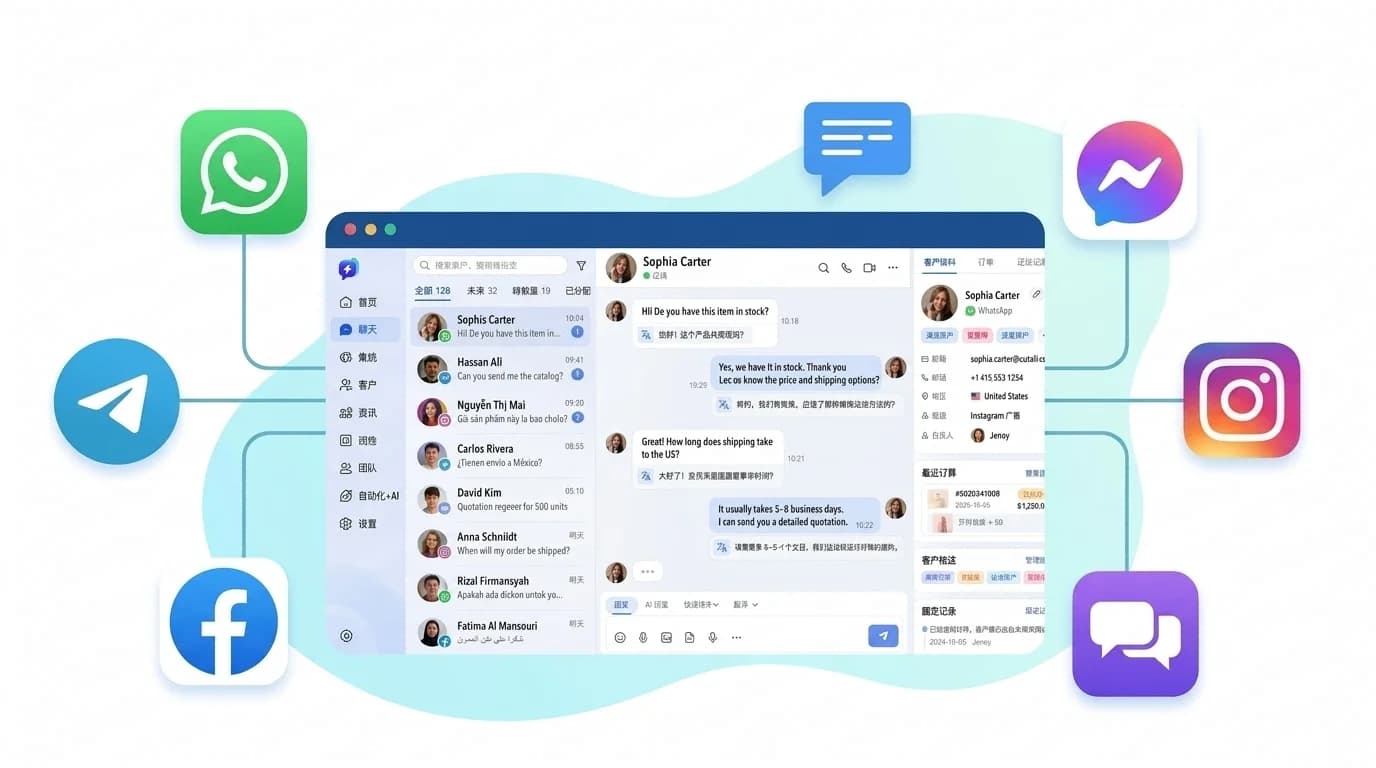
Centralized Message Aggregation: Regardless of whether a customer sends a message via WhatsApp, Telegram, Messenger, or Email, agents can complete instant replies within a single SalesQuickly workbench, completely bidding farewell to the inefficient mode of frequently switching application windows.
Multi-Strategy Intelligent Allocation:
Binding Allocation: Assign specific agents to permanently handle accounts or customers from corresponding language regions.
Load Allocation: Based on the agent's current online status and active sessions, the system automatically assigns new sessions to the agent with the lightest workload.
Unassigned Queue Anti-Double-Booking: New messages initially stay in an "unassigned" queue or are locked by rules. Once claimed by an agent, the session status updates automatically, preventing other staff from repeatedly seizing the chat and completely solving the "double-booking" pain point.
Seamless Context Transfer: When agents need collaboration (such as transferring from pre-sales to after-sales) or cross-timezone shift handovers, the receiving agent can view complete historical communication records and customer CRM data in real time (including customer tags and source ads), eliminating the need for customers to repeat information.
VI. Abnormal Response Mechanism: Real-Time Alerts and Remediation Closed-Loop
In cross-border multi-account operations, network fluctuations and platform risk controls cannot be completely avoided. The key lies in "early detection and early handling":
Real-Time Disconnection Alerts: SalesQuickly features a comprehensive status monitoring mechanism. When hosted accounts experience authorization failure, token expiration, or device disconnection, the system immediately pushes alert notifications to administrators.
Fault Log Recording: Automatically records specific reasons for authorization failures or synchronization interruptions (such as network timeouts or password changes), making it convenient for technical staff to quickly locate issues.
Message Backfill Mechanism: After account reconnections, the system supports automatically capturing customer messages accumulated during disconnection periods, ensuring every customer inquiry can be traced and answered, preventing customer churn.
Violation Risk Early Warning: Establishes sensitive word filtering and abnormal sending frequency monitoring to prevent agents from triggering account risk controls due to inappropriate remarks or abnormally high-frequency operations.
VII. Security Review and Routine Regular Audits
Multi-account management is not a one-and-done deal. Global teams should establish weekly/monthly security review mechanisms, focusing on the following five indicators:
Authorization Health: Check the authorization validity period of all accounts and renew them in advance to avoid sudden disconnections.
Permission Compliance: Review employee role lists, clearing redundant accounts and obsolete permissions.
Log Auditing: Spot-check sensitive operation logs (such as batch exports, frequent transfers, off-hours logins, etc.).
Disconnection Rate Statistics: Analyze disconnection frequencies and causes for each channel account to optimize proxy networks and device environments.
Abnormal Session Inspection: Review sessions with excessively long response times or low customer ratings, extract excellent customer service scripts, and continuously optimize team reception standards.
VIII. Conclusion
Multi-account operations should not become a burden for global teams. By following the four principles of "managing authorizations, clarifying divisions of labor, maintaining full-process audit trails, and conducting routine security audits," combined with SalesQuickly’s efficient multi-account management, cross-channel message aggregation, and unified inbox capabilities, teams can substantially enhance overseas customer response speed and conversion efficiency while safeguarding account security.
Want to boost your global team's communication efficiency and ensure account security?
Register for a free SalesQuickly trial today and unlock full access for 7 days!