How to Handle Cross-Border Translation? Practical Methods and Tool Selection for Multilingual Customer Communication
Struggling with language barriers in global support? Discover 4 practical workflows and compare top translation tools to reply faster with SalesQuickly.

As global expansion accelerates, language barriers have become a major pain point for cross-border businesses entering international markets. When facing high volumes of buyer inquiries across countries and languages, traditional translation tools or manual copy-pasting are not only time-consuming and labor-intensive, but also fail to meet the demands of fast-paced, real-time customer support. To break down these cross-border communication barriers, SalesQuickly created its multi-channel, real-time translation feature—helping global teams connect efficiently with customers worldwide and elevate their multilingual service experience.
I. 4 Practical Methods: Building an Efficient Cross-Border Translation Workflow
To overcome cross-border communication obstacles, teams cannot rely solely on individual agents piecing messages together. Instead, they need a standardized multilingual reception workflow:
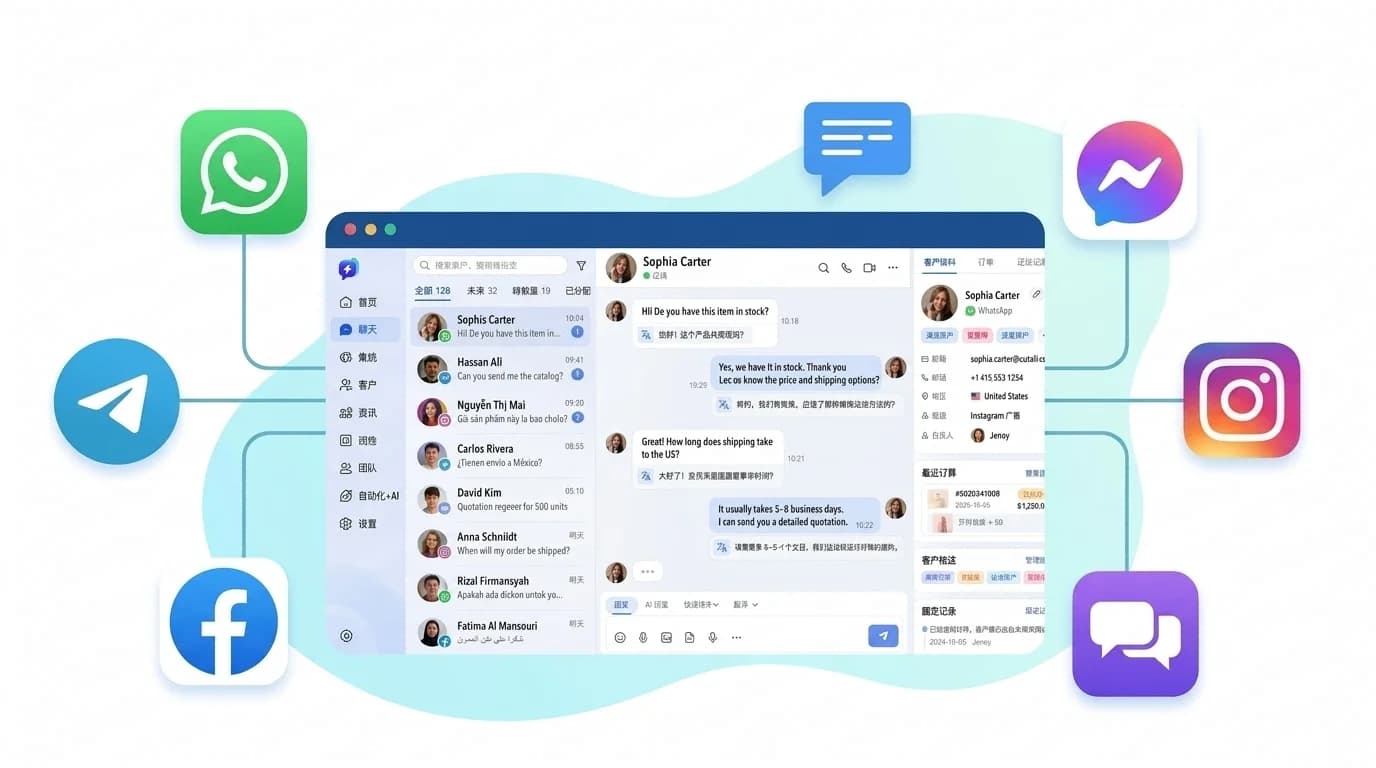
Consolidate an Omnichannel Inbox: Centralize customer inquiries from WhatsApp, Instagram, Messenger, Telegram, Email, and other platforms into a single workspace to prevent missed messages caused by frequent switching between multiple accounts.
Enable Two-Way Real-Time Translation: Achieve direct conversion between the agent and buyer sides—incoming foreign messages are automatically detected and translated into Chinese, while agents can simply type in Chinese and have their responses automatically translated into the customer’s native language, eliminating manual copy-pasting.
Build a Dedicated Enterprise Knowledge Base: Create a standardized knowledge base and preset response templates for product terminology, industry jargon, and FAQs to prevent generic machine translation from causing awkward or inaccurate terminology errors.
Human-AI Collaborative Division of Labor: Use basic automated workflows and smart Q&A to handle high-frequency routine inquiries, while smoothly handing off complex bulk orders or high-value prospects to dedicated multilingual agents for in-depth follow-up.
II. Overview of Mainstream Platforms and Translation Tools
1. SalesQuickly Platform Overview
Built specifically for cross-border businesses, SalesQuickly deeply integrates an omnichannel inbox with multi-channel smart communication. Through unified message collection and tag-based categorization, it helps global teams efficiently manage customer messages across multiple social media channels and eliminate the inefficiency of constantly switching application windows.
Advantages of SalesQuickly’s Real-Time Translation Feature
Supports two-way real-time translation and automatic language detection directly within the chat interface, removing the hassle of switching between web pages or third-party apps. It not only significantly improves response speed for cross-language support, but also works smoothly alongside the knowledge base and tag management—making it ideal for daily multilingual customer support and social media conversion.
2. Google Translate
Features: Supports an extensive range of languages with strong global versatility.
Best For: Broad, everyday communication covering buyers from multiple countries around the world.
3. DeepL Translator
Features: Powered by deep learning, offering exceptionally natural and idiomatic phrasing, with standout performance in European languages (such as German, French, Spanish, and Italian).
Best For: Business communication in European markets where high linguistic accuracy and polished written expression are required.
4. Baidu Translate
Features: Deeper understanding of Chinese context, cost-effective API calls, and strong bidirectional translation capabilities between Chinese and major foreign languages.
Best For: Teams with Chinese-centric business operations seeking high cost-effectiveness and stable API integration.
5. Youdao Translate
Features: Excels in vocabulary accumulation, industry terminology, and context-specific translation, backed by years of specialization in Chinese-foreign language translation.
Best For: Cross-border teams that frequently handle vertical industry jargon alongside daily business conversations.
III. Selection Guide: How to Choose the Right Translation Solution for Your Team
When evaluating solutions, cross-border teams should focus on the following three key dimensions:
Engine Flexibility: Does the system allow you to freely select or switch between suitable translation engines based on target countries or business needs (e.g., Google for English, DeepL for Spanish)?
Native Integration: Is the translation feature built directly into the chat interface? If agents still have to copy and paste across windows, response efficiency cannot be fundamentally improved.
Cost-Effectiveness and Tiered Plans: Does it offer a basic free quota, is the pricing model reasonable, and can it scale flexibly according to your team’s social media accounts and headcount?
IV. Conclusion
Mastering cross-border translation is not just about choosing a piece of software—it is a critical step in building an efficient customer communication loop. By setting up a unified workspace and introducing real-time translation alongside a standardized knowledge base, multilingual support teams can dramatically improve communication quality while maintaining fast response times.
Sign up for SalesQuickly today and boost your global team’s multilingual customer support efficiency!
Originally published by SalesQuickly. Please credit the source when reposting.