How to Use AI-Powered Responses in Customer Communication: Knowledge Base Setup and Operational Boundaries | SalesQuickly
Learn how to use AI-powered responses in cross-border customer communication. Discover best practices for knowledge base setup, RAG testing, and AI boundaries.

In cross-border e-commerce, international trade, and overseas social media management, many teams find themselves trapped in a frustrating cycle: they hire more customer service staff, yet still struggle to keep up with the constant influx of inquiries from abroad. During major promotional events or outside local business hours, potential customers are often lost simply because they do not receive a timely response. Even when a reply is finally sent, language barriers can sometimes make it sound unprofessional or unclear.
Relying solely on human agents—or on rigid, traditional automated systems (e.g., "reply 1 for sizing, reply 2 for pricing")—is no longer sufficient to meet the growth demands of today’s globalized businesses.
Integrating an AI-powered response system with a company’s knowledge base can significantly improve the efficiency of customer communication. This article explores the core logic behind AI-powered responses, how to enable instant, accurate answers via a knowledge base, and the essential boundaries that must be maintained between AI and human intervention.
I. Traditional Automated Responses vs. AI-Powered Responses: What’s the Fundamental Difference?
Many businesses have tried automated responses, often with poor results. This is because traditional systems rely on exact keyword matching—if a customer makes a slight typo or phrases their question differently, the bot fails to understand, leading to an awkward breakdown in communication.
In contrast, the core strength of AI-powered responses lies in natural language understanding (NLU). The AI can look past the casual, unstructured way customers express themselves to pinpoint their true intent. By drawing on an integrated knowledge base, it can craft professional, natural, and fluent responses—much like an experienced customer service representative.
For teams operating internationally, this transforms the system from a cold, mechanical tool into an all-purpose digital employee—available 24/7 and capable of communicating across multiple languages.
II. Which Types of Inquiries Are Best Suited for AI?
While AI is powerful, it is not a universal solution. To maximize its effectiveness, it should be applied where it can deliver the most value. AI is particularly well suited to handling the following types of inquiries:
Standardized product information and specifications: Clothing size charts, compatibility information for electronic products, material composition, and available colors.
Frequently asked pre-sales questions: Supported shipping destinations, estimated delivery times, and shipping cost calculation rules.
Core store policies: Return and exchange policies, warranty terms, and accepted payment methods.
After-hours coverage: Instant responses to inquiries received outside local business hours, helping businesses capture initial customer interest across time zones.
III. Building an AI "Golden Brain": How to Enable Instant Q&A via a Knowledge Base
The effectiveness of an AI agent depends heavily on the quality of the knowledge base it uses. Many companies struggle with AI implementation simply because their knowledge base is superficial. Building a high-quality knowledge base involves three core steps:
Content audit and structuring: Systematically organize scattered materials—such as product manuals, historical customer service FAQs, and logistics or after-sales policies—into clear question-and-answer pairs.
Regular, dynamic updates: The knowledge base must be kept up to date with product updates, price adjustments, and changes to promotional policies to prevent the AI from making incorrect promises based on outdated information.
Leveraging validation tools: Before deploying the system for international customers, use a debugging interface to stress-test it by simulating the challenging or complex ways customers might ask questions. Monitor the retrieval-augmented generation (RAG) process to ensure that the AI’s responses are grounded in verified information.
IV. Defining the Red Lines: AI Boundaries and Human Handoff Mechanisms
While AI can handle a large share of routine, repetitive inquiries, it can never replace human business judgment. In practice, two clear boundaries must be established:
Strict prohibition of unauthorized commitments: While the AI can look up prices and policies, it must never independently negotiate bulk pricing, promise special discounts, or guarantee refunds that fall outside official policy.
"Circuit breakers" for sensitive situations and complaints: In cases where a customer is highly emotional, reporting a serious product quality issue, or involved in a complex compliance dispute, the AI should automatically trigger a fallback response and immediately escalate the conversation to a human supervisor. In daily operations, companies should establish a collaborative workflow in which AI-generated drafts are reviewed and refined by human agents, or use the "AI-managed mode" toggle in the admin panel to flexibly control when AI intervenes.
V. Balancing Computing Power and Costs: How to Manage AI Credits Effectively?
While leveraging AI to drive efficient communication, businesses must also carefully manage operational costs. On platforms like SalesQuickly, the use of AI features is typically tied to an AI credit system.
Value of credits: AI credits are used for core, resource-intensive functions such as intelligent Q&A, information retrieval by AI agents, and conversation analysis.
Management best practices: Companies should regularly check their credit balance and review a breakdown of their usage in the "Subscription" section of the admin panel. By streamlining the knowledge base (removing redundant information), optimizing prompts, and clearly defining the scope of AI-automated responses, businesses can ensure rapid response times for frequent inquiries while maximizing the return on investment (ROI) for their AI implementation.
VI. A Long-Term Mechanism for Continuous Evolution
Implementing AI is not a one-and-done project. To ensure that AI-powered responses become increasingly intelligent over time, teams should incorporate two key operational routines:
Reviewing blind spots: Periodically analyze conversation logs and instances where the AI failed to provide an answer. Use these insights to fill gaps in the knowledge base by adding information that customers frequently ask about but is currently missing.
Strategic resource planning: Maintain a balance between AI credit consumption and daily operational needs. Continuously refine your prompts and optimize the content and scope of your knowledge base to ensure that every investment translates into tangible cost savings and increased efficiency.
Conclusion
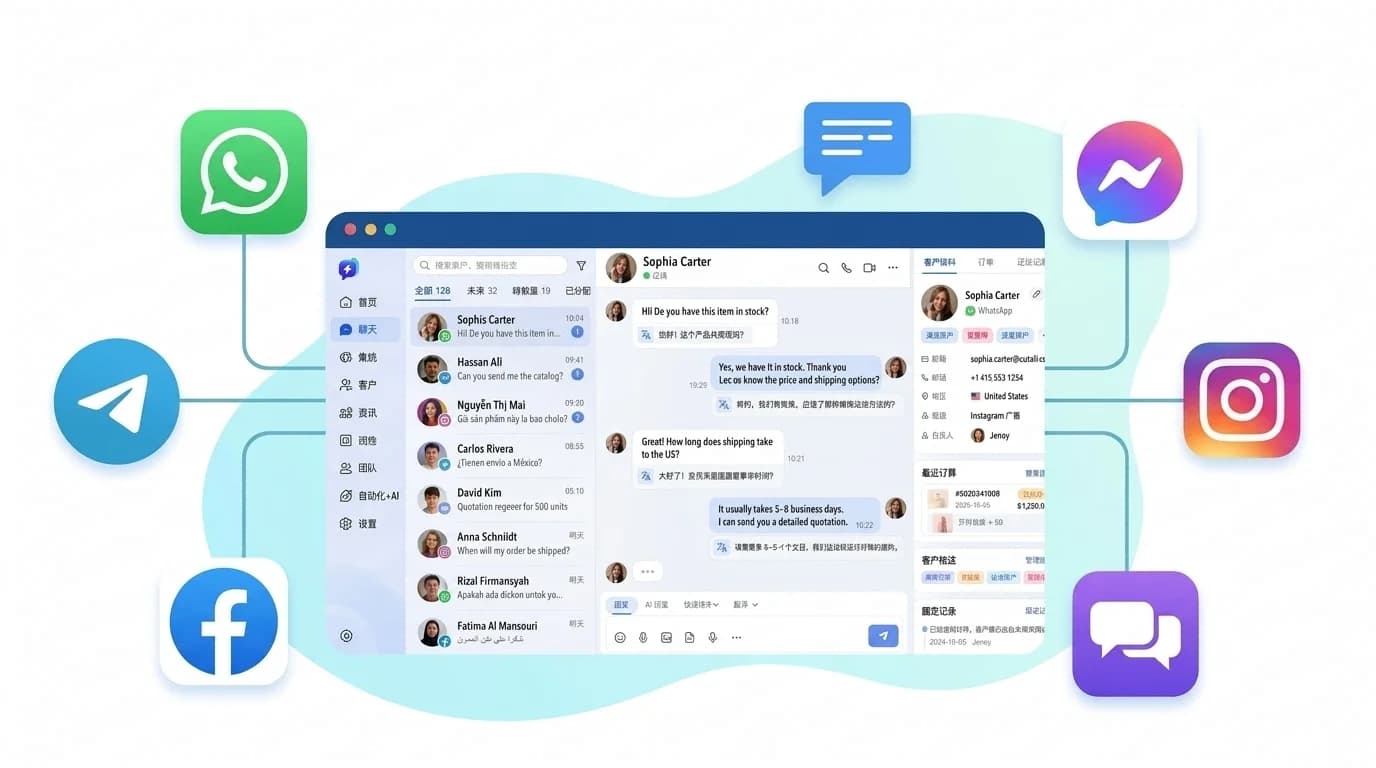
Building an efficient AI-powered response system and knowledge base is no longer a technical barrier reserved only for large enterprises. SalesQuickly—an AI-driven, omnichannel communication and customer management platform designed for businesses expanding globally—goes beyond simply aggregating messages from various channels into a unified workspace. It offers deep integration with AI agents, dedicated knowledge bases, RAG debugging tools, AI credit management, and flexible mechanisms for human intervention and oversight.
If your team is struggling with a high volume of international inquiries, slow response times across multiple languages, or the risk of missing leads overnight, consider signing up for SalesQuickly today. Let AI handle routine, repetitive communications so your sales and customer service teams can focus on high-value sales opportunities and customer relationships.
Originally published by SalesQuickly. Please credit the source when reposting.